Splendid colour tips for quilters: Versatile ways to use just one colour
This post is one of my Splendid colour tips series, where I share information to help you choose fabrics and colours for your quilts with more confidence. Today’s post is a little different because it isn’t about any specific colour. Instead, it discusses how you can use a single colour to effect in your quilt.
One colour can be surprisingly versatile in quilting, and perhaps this post encourages you to experiment a little. I suggest three basic ways to discover the versatility of using just one colour in a quilting project: When you are picking fabrics for single-coloured blocks, make sure that there is value contrast. After all, there is going to be very little colour contrast there! As an example, two flying goose blocks in the uppermost block don’t have enough contrast:
 When you look at the block from further away, the goose pattern in those flying geese pieces won't stand out and the pieces will look like rectangles.
Then, pick a neutral (or two) to use with your colour. A neutral that isn’t of a particular colour: black, grey, white, cream, beige, or even a very dark blue or brown.
You can now pull all your colour fabrics of one colour: light and dark, medium-value, warm or cool hued, solid, or patterned. The colour of your choice must be dominant in the patterned fabrics that you pick.
For example my Ring around the Rosy / Piiri pieni pyörii is a red-and-white quilt. The red fabrics range from light to dark and from fire-engine red to pink, orange, and maroon: I applied a similar rule to most of the blocks I made for the Twinkle! quilt. Though the light and dark parts of the block could be neutrals (very light or white, or very dark or black) or of the colour that I picked for the block:

 My quilt is not of one colour because I added a round of purple and red hued blocks each, but you can see the centre is blue, which would work for an all-over look as well.
Here’s another example from the same project; some of the purple blocks: See how there is rhythm because there is a clear value contrast between the centre square and the surrounding strips? The design is interesting and pleases the eye, and yet the blocks feature only a single colour. That is versatility!
If you want to make a single-coloured quilt with similar pop corn or potato chip blocks, start by reviewing your fabric stash – not your scraps – and then choose one colour that you have lots of. Next, pull out the fabrics, split them into lighter and darker and start cutting and sewing.
However, working with one colour in these three ways has made me realise that the single-colour approach will almost always make the quilt feel more intentional. Even with a wide variety of prints, the repeating colour will read as a deliberate design choice.
One-colour projects reduce the risk of visual chaos.
I’ll be discussing another colour-related topic in two weeks' time, sharing tips and stories from my own quilts. If you want to be sure to get all my colour tips – and possibly other fun updates as well – you can subscribe to my biweekly newsletter.
(When subscribing, remember to take the second step: you will get an email asking you to confirm. My emailing system can only send you the newsletters if you have clicked on the button in that email.)
One colour can be surprisingly versatile in quilting, and perhaps this post encourages you to experiment a little. I suggest three basic ways to discover the versatility of using just one colour in a quilting project:
- Create a scrappy surface
- Make single-coloured blocks
- Choose one colour and complement it with a neutral
I’ve illustrated these three ways with examples of my quilts and quilted items. I also give an answer to the question: “Could the whole quilt be of one colour?”

If you have a mishmash of scraps at hand, take them up and organise them into piles by colour. One pile for reds, another for blues, a third one for greens... And if you come up with a scrap that doesn’t seem to fit into any of the colour piles, put it aside.
When you have those single-colour piles, you have excellent material to use in your exploration to what kind of scrappy surface you can create only from one pile.
If your single-colour pile of scraps is big enough, you may be able to create a piece large enough for a zipper bag. This can make for a fun project. Perhaps you haven’t liked a multicoloured, scrappy look? But a curated selection of scraps helps ensure a cohesive result even if you do use every possible hue of a single colour.
For example, this Kuutonen/Six zipper pouch that I sewed of only yellow scraps (or of scraps that I categorised as yellow): The zipper pouch does not feature a particular pattern, and the scraps have been sewn together without a plan. Yet, the design doesn't look chaotic.
If you feel uncomfortable about sewing different-sized scraps together, you may find inspiration in my earlier post "How I turn a pile of scraps into an intentional-looking quilt surface” – and the last tip about creating a mini “lasagna” could be just for you.
I came up with the mini lasagna idea when turning scraps into pop corn blocks in 2015. When I’d cut out as many “logs” out of a scrap as possible, I cut the remainder into one-inch strips, then sewed them into a really long strip, to which I applied the “lasagna” or “jelly roll race” method.
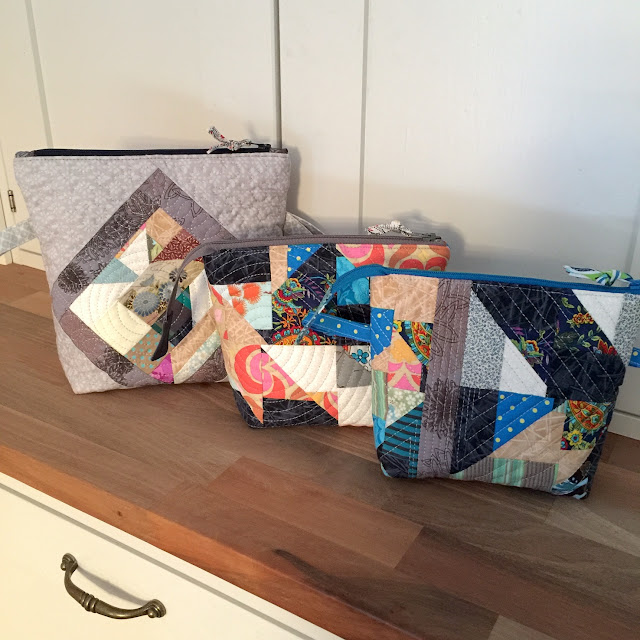
You can see the resulting piece at the centre of the quilted zipper pouch surface: This is one the easiest way to bring different scraps into use – and to be sure that your finished item looks cohesive in its scrappiness.
This is what you do with such a scrap: find its most dominating colour and treat it as that-coloured. For example, this flower-patterned fabric could be categorised as “pink” - but you could just as well categorise it as “turquoise”. Some patterned fabrics feature colours so uniformly that it’s hard to decide “which colour they are”. Just make that decision and treat the fabric as of that colour throughout your project. You will see that an occasional multicoloured scrap like that will add interest to your single-coloured layout.
When fabrics share a similar value and colour family, they often look more alike than you'd expect, even if the prints themselves are completely different:
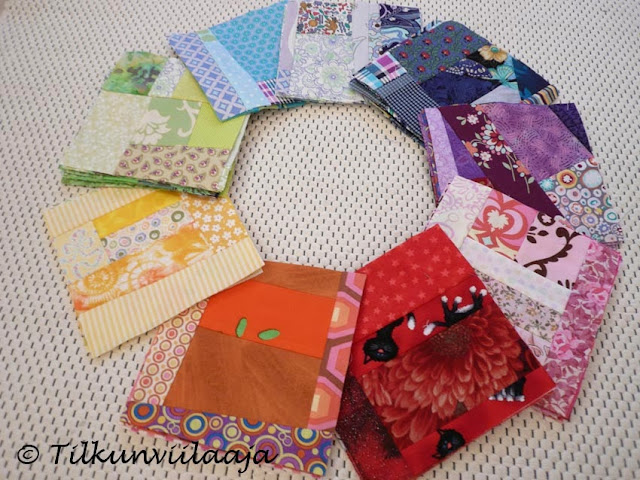 When you have enough squares, add a sashing and you have a quilt top. For my Inner Sweater / Sisäinen villapaita quilt, I used a slightly more elaborate sashing, which created an illusion of squares floating on a striped background:
 One-colour blocks work because each block looks planned, not random.
You can also sew your scraps together into larger, one-colour pieces and use those as background for an applique. Less value contrast between the scraps will ensure that your applique will stand out from the background. This is an example of a low-volume background for a piece that I’d sewn using the EPP method. You can apply the “one colour for one block” rule not only to simple scrappy squares, but block patterns as well. The Early to Rise quilt is an example of this: I sewed each block of same-colour fabrics (and scraps):

1. Create a scrappy surface
Using your fabric scraps is a low-threshold way to start exploring the idea of using just one colour in a quilt project.If you have a mishmash of scraps at hand, take them up and organise them into piles by colour. One pile for reds, another for blues, a third one for greens... And if you come up with a scrap that doesn’t seem to fit into any of the colour piles, put it aside.
When you have those single-colour piles, you have excellent material to use in your exploration to what kind of scrappy surface you can create only from one pile.
If your single-colour pile of scraps is big enough, you may be able to create a piece large enough for a zipper bag. This can make for a fun project. Perhaps you haven’t liked a multicoloured, scrappy look? But a curated selection of scraps helps ensure a cohesive result even if you do use every possible hue of a single colour.
For example, this Kuutonen/Six zipper pouch that I sewed of only yellow scraps (or of scraps that I categorised as yellow):
If you feel uncomfortable about sewing different-sized scraps together, you may find inspiration in my earlier post "How I turn a pile of scraps into an intentional-looking quilt surface” – and the last tip about creating a mini “lasagna” could be just for you.
I came up with the mini lasagna idea when turning scraps into pop corn blocks in 2015. When I’d cut out as many “logs” out of a scrap as possible, I cut the remainder into one-inch strips, then sewed them into a really long strip, to which I applied the “lasagna” or “jelly roll race” method.
You can see the resulting piece at the centre of the quilted zipper pouch surface:
What colour are multicoloured fabrics?
When sorting through your scraps, you’ve created single-colour piles – and that one pile of fabrics that you weren’t sure about. Those fabrics are likely to feature many different colours, and they are indeed difficult to categorise.This is what you do with such a scrap: find its most dominating colour and treat it as that-coloured. For example, this flower-patterned fabric could be categorised as “pink” - but you could just as well categorise it as “turquoise”.
When fabrics share a similar value and colour family, they often look more alike than you'd expect, even if the prints themselves are completely different:
2. Make single-coloured squares or blocks
Instead of creating a single-coloured zipper bag, you can make scrappy squares (or squarish pieces that you press and trim to size) that are each of one colour. This is how I first discovered the power of a single colour.You can also sew your scraps together into larger, one-colour pieces and use those as background for an applique. Less value contrast between the scraps will ensure that your applique will stand out from the background. This is an example of a low-volume background for a piece that I’d sewn using the EPP method.
3. Choose one colour – and a neutral
If you feel uncomfortable with the idea of using only one colour, here is another option to consider. First, you will choose your colour. Your favourite colour is always a safe choice, but you could also pick a colour that is abundant in your fabric stash.Then, pick a neutral (or two) to use with your colour. A neutral that isn’t of a particular colour: black, grey, white, cream, beige, or even a very dark blue or brown.
You can now pull all your colour fabrics of one colour: light and dark, medium-value, warm or cool hued, solid, or patterned. The colour of your choice must be dominant in the patterned fabrics that you pick.
For example my Ring around the Rosy / Piiri pieni pyörii is a red-and-white quilt. The red fabrics range from light to dark and from fire-engine red to pink, orange, and maroon:
Could the whole quilt be just one colour?
Many quilt patterns are well suited for a project that uses a single colour, only in different values and hues. I have an example that is based on so-called pop corn or potato chip blocks: Grandma’s House / Mummola quilt:Here’s another example from the same project; some of the purple blocks:
If you want to make a single-coloured quilt with similar pop corn or potato chip blocks, start by reviewing your fabric stash – not your scraps – and then choose one colour that you have lots of. Next, pull out the fabrics, split them into lighter and darker and start cutting and sewing.
Final thoughts about using just one colour in a quilt
I love colours! Multicoloured scrappy surfaces can be surprising – so if you are seeking a lively look with unexpected combinations, multiple colours are better. At the same time, they can feel more difficult to balance or “get right”.However, working with one colour in these three ways has made me realise that the single-colour approach will almost always make the quilt feel more intentional. Even with a wide variety of prints, the repeating colour will read as a deliberate design choice.
One-colour projects reduce the risk of visual chaos.
Earlier posts in the splendid colour tips series
I’ll be discussing another colour-related topic in two weeks' time, sharing tips and stories from my own quilts. If you want to be sure to get all my colour tips – and possibly other fun updates as well – you can subscribe to my biweekly newsletter.
(When subscribing, remember to take the second step: you will get an email asking you to confirm. My emailing system can only send you the newsletters if you have clicked on the button in that email.)


Comments