Splendid colour tips for quilting: Brown in quilts
Today’s post concentrates on brown colour in quilts. It may not be the most exciting colour, but it can be very useful! You will get a tip or two on what to watch out for and many examples of how to use brown fabrics in your quilts with success.
 Brown is a colour in its own right, even though it is not one of the colours of the rainbow. One can also think of it as a very dark orange. In the CMYK colour model, brown is created by mixing yellow, magenta, and black.
I remember the carboard palettes of watercolours at school: one got brown by mixing red, yellow and blue. The result was usually an ugly brown. And the water used for cleaning the brush became rather an unattractive shade of brown after one had dipped the brush in it a couple of times.
Wikipedia mentions that both European and US polls reveal that brown is the people’s least popular favourite colour. (Source: https://en.wikipedia.org/wiki/Brown)
For example, this Corners / Nurkat quilted bag might look drab (to me at least) without the pink diamond shapes pepping it up: If brown is not your favourite colour, sewing blocks in brown fabrics one after another may become boring after a while. I know this from a project from 2015. The quilt blocks were quite fun, but I got tired of the browns!
 I remember that I had to take many breaks in between working on these blocks. But finally, I finished the Witches’ Brooms / Tuulenpesät quilt – more than three years from the start. I’m glad that it turned out quite nice after all:
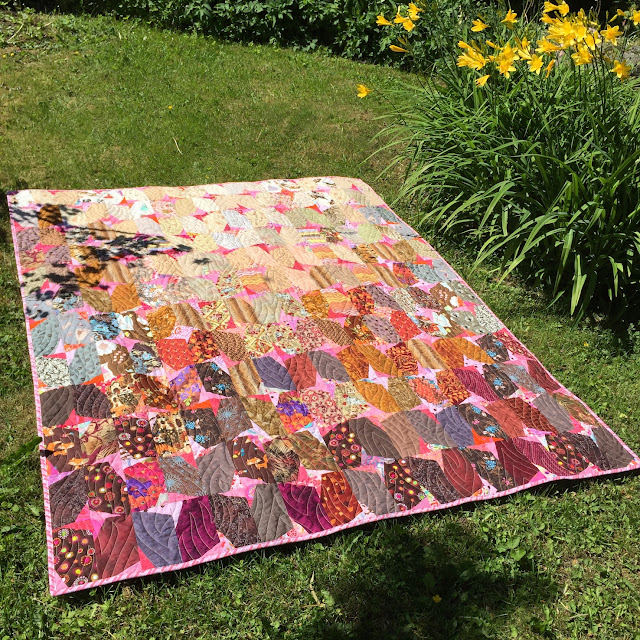
Brights will pop up from a brown background, like in my Amity quilt: Speaking of the Amity quilt, I’ve made three versions using the same pattern, and Amity is the latest one. Before it, I made Old Friends / Vanhat ystävät, also using brown neutrals. The latest Amity and this Old Friends look very similar.
 The first one that I made using this pattern was called Happy Surprise / Iloinen yllätys in 2012, and I did not use browns but reds and greens (because I had large enough pieces of those colours in my stash).

The Amity quilt pattern is available in the Tilkkunen webshop as a downloadable PDF.
Back to the topic -
A dark, nearly solid brown works well as one of the sashings (or block borders, if you will) In the Yli järven / Over the Lake quilt. And thanks to the scrappy squares and the contrasting sashing strips, the quilt doesn’t appear overwhelmingly brown. Brown fabrics can go extremely nicely together with the right turquoise. Why not test the combination in a smaller surface? I did so in my In the Evening / Iltasella zipper bag, achieving a nice cooperation between the browns and turquoises:
 If you want to see more tips on combining turquoise with other colours, check my Turquoise colour in quilts post.)
As we saw before, pinks – pale or not – can pep up browns. The Ice Cream Summer / Jäätelökesä from 2012 is a good example of this. I picked fabrics in brown, pink and pale pink and used a white-ish fabric for sashings. Some parts of the quilt remind me of the “trio ice cream” that combines chocolate, strawberry, and vanilla flavours. Perhaps worth testing! Browns will also go well with reds, when you make sure that there is enough value contrast (and colour contrast). The Fair Game / Reilua peliä quilt is a good example:
 A tiny comic relief –
See this quilt! It is related to the colour brown though you might not think so, looking at this picture: I named it This Is Not Brown / Tämä ei ole ruskea even though the finished quilt reminds me more of sherbet colours. You see, I had left the blocks into a relatively random order on the design floor (our bedroom floor) overnight. On the next day, I took the blocks to the design wall and organised them properly.
The blocks were large and there weren’t that many to sew together. The surface was quickly done. I spread the surface on the design floor again, and when my husband came upstairs that evening, I asked what he thought of it; didn't it turn out nice!
The blocks must have looked more brown together when they were in random order, because he paused, looked puzzled and asked: ”Where did the brown quilt go?”

I remember the carboard palettes of watercolours at school: one got brown by mixing red, yellow and blue. The result was usually an ugly brown. And the water used for cleaning the brush became rather an unattractive shade of brown after one had dipped the brush in it a couple of times.
Wikipedia mentions that both European and US polls reveal that brown is the people’s least popular favourite colour. (Source: https://en.wikipedia.org/wiki/Brown)
What to watch out for when using brown
Too much brown may make the quilt surface look grungy and dreary. Do you have the same main recollection of the 1970’s like me: that everything was brown? Or brown combined with a dull green? Or orange? (Or maybe you are too young to remember the 1970's...)For example, this Corners / Nurkat quilted bag might look drab (to me at least) without the pink diamond shapes pepping it up:
How to use brown successfully in a quilt surface?
Brown is a splendid neutral for a quilt. It goes nicely with many colours, as long as you take care of the value contrast (and colour contrast). In other words, make sure that your neutral browns are clearly lighter or darker than the focus colours in your quilt surface.Brights will pop up from a brown background, like in my Amity quilt:
The Amity quilt pattern is available in the Tilkkunen webshop as a downloadable PDF.
Back to the topic -
A dark, nearly solid brown works well as one of the sashings (or block borders, if you will) In the Yli järven / Over the Lake quilt. And thanks to the scrappy squares and the contrasting sashing strips, the quilt doesn’t appear overwhelmingly brown.
As we saw before, pinks – pale or not – can pep up browns. The Ice Cream Summer / Jäätelökesä from 2012 is a good example of this. I picked fabrics in brown, pink and pale pink and used a white-ish fabric for sashings. Some parts of the quilt remind me of the “trio ice cream” that combines chocolate, strawberry, and vanilla flavours. Perhaps worth testing!
See this quilt! It is related to the colour brown though you might not think so, looking at this picture:
The blocks were large and there weren’t that many to sew together. The surface was quickly done. I spread the surface on the design floor again, and when my husband came upstairs that evening, I asked what he thought of it; didn't it turn out nice!
The blocks must have looked more brown together when they were in random order, because he paused, looked puzzled and asked: ”Where did the brown quilt go?”


Comments