How I turn a pile of scraps into an intentional-looking quilt surface
This is a modern quilting blog focused on patchwork, scrappy quilts, zipper pouches, quilted bags, colour theory, and practical quilting tutorials. I share finished projects, design processes, tips, and lessons learned.
Today’s post gives you three ideas for improvising with your scraps so that you will end up with an intentional-feeling quilt surface.
Many people still associate the term “scrappy” with a result where anything goes. This is of course one way of approaching a pile of scraps that may have accumulated from a dozen projects or more. It is an easy way and can be relaxing.
Because a quilt surface tends to benefit from a bit of order, structure, or rhythm, I’ve developed my own approaches to scrappy quilting. One is based on colours, another is based on shapes, and the third applies the “jelly roll race” or “quilt lasagne” method to scraps.
 I begin with a very small scrap, the centre, and use the log cabin block method to surround it with other scraps. Rectangles or strips work best, and it is a good idea to get value contrast between the centre and the logs. If the centre is dark, find lighter logs and vice versa:
 In the picture, the upper surface shows the scrappy square-in-a-box pieces. You can see that the logs don’t all have to be of the same fabric. It’s enough that the logs are the same colour and sort of the same value.
The scrappy square-in-a-box pieces then get a good press. And the next step is important: I trim the pieces to a certain width (or certain widths, narrower and wider). The height can vary, but when the width matches, the pieces are easy to sew together.
These surfaces have two wider columns and one narrower column each. Colours may be whatever, but because there is order, the surfaces look intentional: In just a few days, those scrappy pieces had become a quilted zipper bag called Window Princess / Ikkunaprinsessa.
 Note that the repeated shapes create order – and the value contrast between the centre and the logs makes the shapes visible. If they were of the same value, you would not get the same effect.
Starting position. I had a paper bag full of scraps in all possible colours, shapes and sizes. There seemed to be many strips, shorter and longer. First, I sorted the scraps according to colour: neutrals, yellows, greens and reds are visible:
 I also had a pile for blue fabrics and a pile called “the rest” into which I moved the scraps were of any other colour.
I started with the yellow and green piles. First, I found a squarish piece in yellow and in green to use as the centre “square”. I then framed the center using the log cabin method: yellow centres got a green surrounding and vice versa.
I didn’t even try to find strips that would be long enough for the whole round of logs. Instead, I picked the logs based on their length – I used whichever piece was nearest the length that I needed for the next log.
It did not take long to make five small square-in-a-box blocks. Here they are after pressing: Three of the blocks had the same height or thereabouts, and the other two also shared a measurement. I would be able to create a two small rows of blocks.
In addition, I noticed that the two rows would be of the same length if I added a small strip between the two larger blocks. I did that and had two rows that could be sewn into a single piece.
 Because the resulting yellow-green surface was a little small, even for a zipper bag, I picked up a pile of blue fabrics and used them for three more blocks. And what do you know: they were just the right thing to add to the yellow-green surface:
 The piece did not become a zipper bag: instead, I added a few more small pieces to the surface and it became the front panel of a small, quilted handbag:
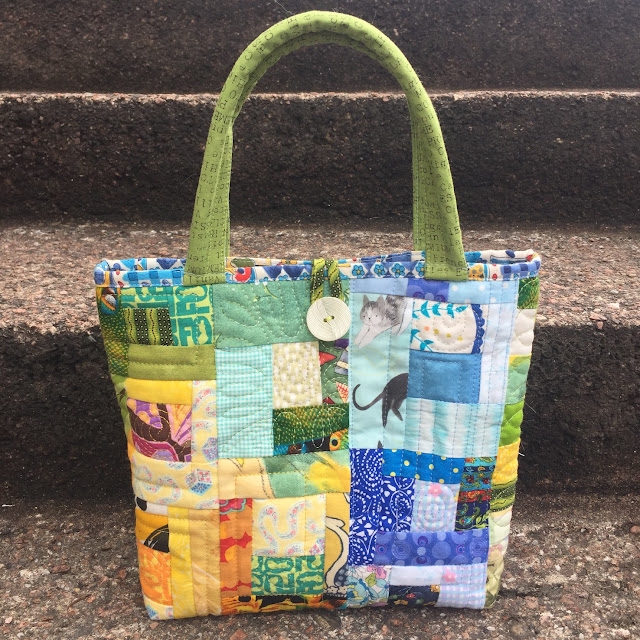 The surface in the handbag looks scrappy – and yet, intentional. You can see from my process that I did not plan things in advance or aim for a certain result. The limited colour palette and the repeating shapes bring in order, but if I hadn’t taken care of value contrast, that order would not be visible. Again, value does the work.
When you have enough strips, sew them into a single, really long strip.
Then fold that strip in half and sew the long sides together. Cut the fold open, and you will have a long, slightly wider strip. Fold that in half, sew the long sides together and cut the fold open.
Continue until your piece is of suitable length and width.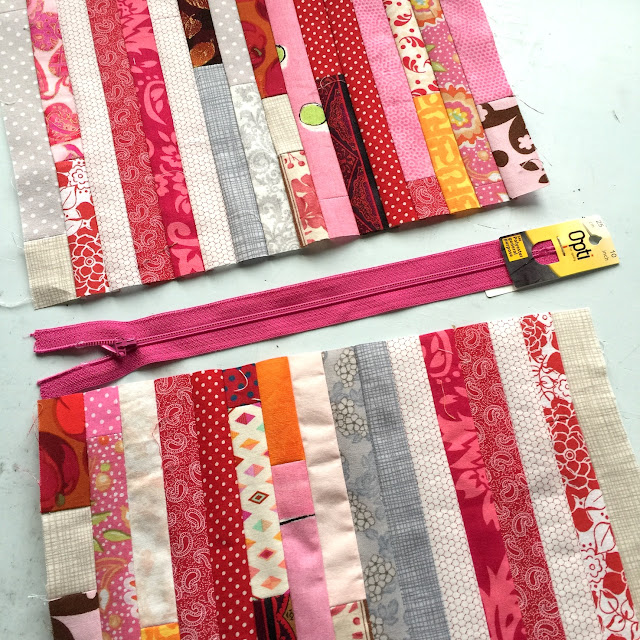 Missouri Star Quilt Company has explained the method in this video. You will just use much narrower strips for the mini version.
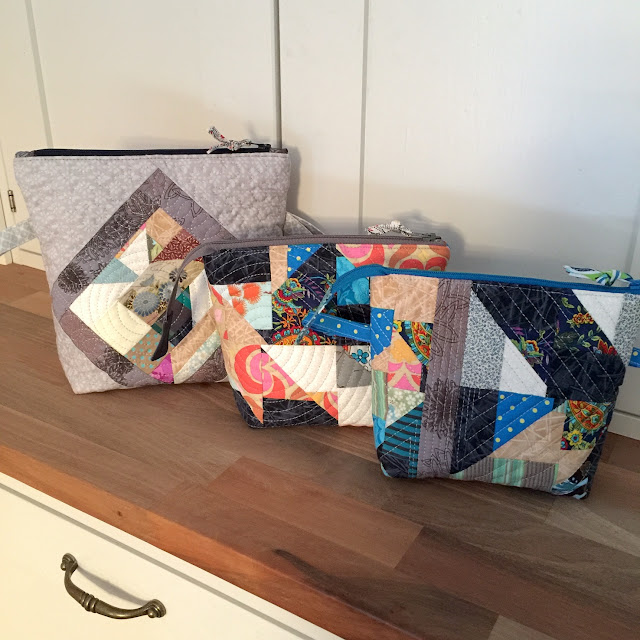
The lasagne piece may be large enough to become a zipper bag surface. If not, you can cut the piece horizontally and combine them with other scrappy pieces:
With simple rules, you can still enjoy working with scraps in an improvised way, and yet, the results will be more than “anything goes”. If you want to follow what I’m working on and what I’ve finished (and get some quilting tips, too), you can subscribe to my biweekly newsletter here: https://tilkunviilaaja.blogspot.com/p/subscribe-today.html
Today’s post gives you three ideas for improvising with your scraps so that you will end up with an intentional-feeling quilt surface.
Many people still associate the term “scrappy” with a result where anything goes. This is of course one way of approaching a pile of scraps that may have accumulated from a dozen projects or more. It is an easy way and can be relaxing.
Because a quilt surface tends to benefit from a bit of order, structure, or rhythm, I’ve developed my own approaches to scrappy quilting. One is based on colours, another is based on shapes, and the third applies the “jelly roll race” or “quilt lasagne” method to scraps.

Scrappy improv quilting – repeated shapes creating order
This method is based on improv piecing square-in-a-box blocks. The process starts from a random pick of small scarps:The scrappy square-in-a-box pieces then get a good press. And the next step is important: I trim the pieces to a certain width (or certain widths, narrower and wider). The height can vary, but when the width matches, the pieces are easy to sew together.
These surfaces have two wider columns and one narrower column each. Colours may be whatever, but because there is order, the surfaces look intentional:
Scrappy improv quilting – a limited colour palette creating order
The method is also based on improv pieced square-in-a-box blocks. In the following example I have also limited my colour palette according to the first method. I’ll show you one of my projects from start to finish.Starting position. I had a paper bag full of scraps in all possible colours, shapes and sizes. There seemed to be many strips, shorter and longer.
I started with the yellow and green piles. First, I found a squarish piece in yellow and in green to use as the centre “square”. I then framed the center using the log cabin method: yellow centres got a green surrounding and vice versa.
I didn’t even try to find strips that would be long enough for the whole round of logs. Instead, I picked the logs based on their length – I used whichever piece was nearest the length that I needed for the next log.
It did not take long to make five small square-in-a-box blocks. Here they are after pressing:

In addition, I noticed that the two rows would be of the same length if I added a small strip between the two larger blocks.
Six tips for improvising with scraps of many shapes and sizes
- See that your seams are straight. You can trim your pieces or draw a straight line on the wrong side of the fabric.
- Press. It would be ideal to press each seam as you’ve sewn it, but I usually press only when I’ve sewn a whole round of logs in. (If I were to sew a second round, I would press and trim the piece before starting it.)
- You can remind yourself that all your scraps are leftovers. It’s ok to cut them smaller, or lengthen with another, similar-coloured scrap, or use them wrong side up.
- Because it’s quick to sew together one of these blocks, you should not stop to analyse whether the hues or patterns match. Within your colour scheme, everything goes!
- Value contrast is more important than matching fabric patterns or colours. The quilt surface will be more interesting when you there are light and dark shapes in it.
- A block that you make may seem ugly to you, but that doesn’t mean that it would not work together with your other blocks!
Improvising with scraps - mini quilt lasagne method
If you have many narrow, rectangular scraps, you could try the miniaturised quilt lasagne method (also called jelly roll race). Take those longer leftovers and cut them into one-inch wide strips. Different strip lengths make the resulting surface more interesting.When you have enough strips, sew them into a single, really long strip.
Then fold that strip in half and sew the long sides together. Cut the fold open, and you will have a long, slightly wider strip. Fold that in half, sew the long sides together and cut the fold open.
Continue until your piece is of suitable length and width.
The lasagne piece may be large enough to become a zipper bag surface. If not, you can cut the piece horizontally and combine them with other scrappy pieces:
My final thoughts about scrappy quilting
It is surprising how easily a random pile of scraps can be turned into an intentional-looking scrappy surface. You can improvise without a plan - but setting some rules will help achieve that intentional feel. Limiting your colour palette or the shape of your pieces are just two examples of rules that you can develop.With simple rules, you can still enjoy working with scraps in an improvised way, and yet, the results will be more than “anything goes”.


Comments