7 things I’ve learned about making quilted zipper bags
I’ve made more than 360 zipper bags during my 16+ blogging years. Over the years, I’ve learned so many things – not only about sewing zipper bags, but how to use scraps, colour, and contrast, where to place the focus pieces on the surface, and the best ways to quilt them to effect.
Some of the learnings came because my methods and techniques developed. Others I learned through mistakes, or by reflecting on why I liked or did not like one creation or another.
For example, I’ve realised that scrappy zipper bags can benefit from having visual order, that value contrast matters more than matching fabrics, and that the density of quilting will change how a bag looks and feels. I’ve also been surprised to learn how different people’s preferences are when it comes to size, shape, or colour. It’s liberating to know that a standard shape and size is not the only way to go!
In this post, I will share my learnings – including one thing that can make your zipper bag look classily handmade instead of amateurishly homemade. If you already know the basics of making zipper bags and want to make scrappy, quilted ones that look more intentional, these lessons may save you some trial and error. Here are seven things 360+ zipper bags have taught me.
But scrappy doesn’t have to mean random, or that everything goes. Even though I don’t plan my surfaces beforehand, I usually create some kind of visual order. I have several go-to methods to achieve that.
For example, I may take an unorganised batch of scraps, sort them by colour and see if I’d like to make surfaces with one colour (different shades and values) or perhaps with two colours. Sometimes I sort the scraps into pieces and strips (and larger pieces that could be cut into strips). Then I make scrap-in-a-box blocks out of them. I do not measure, I just sew strips around the centre scrap – which doesn’t have to be a square.
 I press the finished blocks, then trim them into rectangles, not squares. The idea is to trim them so that at least some of them can be sewn together with minimal wastage.
Here, I noticed that I only needed one additional strip to make these five blocks into a larger rectangle: These are two ways to create visual order – sometimes subtle, but order all the same, making the scrappy surfaces feel more intentional.
When I use cashier’s receipts as foundation, my results are often ombre kinds of rows/columns: Two ombre strips can enhance each other when their colour gradation runs in opposite direction, like in this Orastava zipper bag (which also features one of the pieces shown in the previous image):
 This is also a great way to hide your ugliest fabrics – in an ombre row/column, one won’t notice the ugly.
 And the Little Bag / Pikkupussi is another example:
 This would not be a Tilkunviilaaja blog if I didn’t mention value contrast! A quilt surface with lighter and darker areas will be more interesting to the eye than one that is of same value throughout. I think value contrast is more important than whether your fabrics ”match”.
For example, this surface on the Bahama zipper bag would not be as memorable if I’d used paler red/pink fabrics for the scrappy diamond: Another way to achieve contrast is to use a combination of busy and not-so-busy prints. These surfaces have a wide selection of prints, big and not so big – and also some solids for contrast:

The Lower Corner / Alakulma zipper bag surface looked great until I’d sewn it into bag shape. Only then did I remember that I should not have middle aligned the focus piece: Here’s another example, the Twosome/Kaksin zipper bag from 2018:
 An example of a zipper bag where the focus scrap sits comfortably near the top. This Beach Vacation / Rantaloma bag looks much more intentional:
 It’s so easy to look at the scrappy surface that one is creating and not consider the part of that surface that is going to be the bottom of the bag!
However, a selection or different sizes and shapes may be more stop-worthy for your potential customers. People who know how to take full advantage of zipper bags will think in terms of what to store inside them.
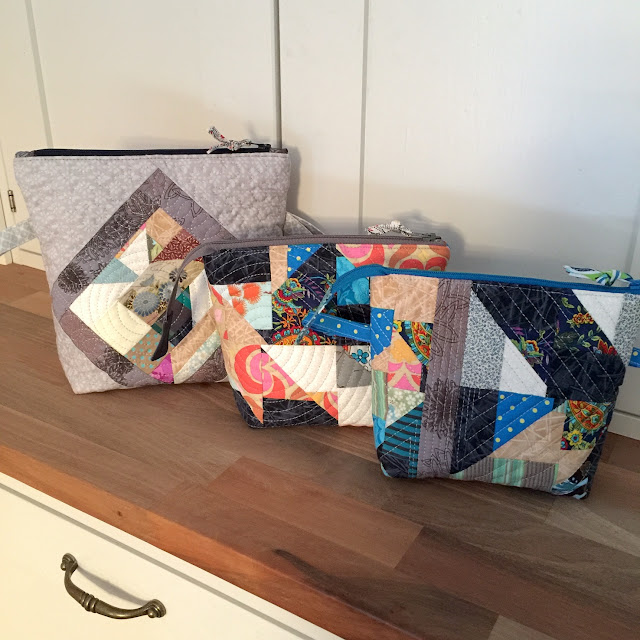
I have made zipper bags in a wide variety of sizes and shapes, and a surprising number have found an owner – perhaps because the bags have been so different. Here are some of the most extreme examples.
Friday Bag /Perjantaipussukka from 2018 is an example of a very small bag. Width at the top is 14,5 cm / 5,5” and height 11 cm / 4,5”. Voluminous/Muhkea from 2023 is really big for a zipper bag: width at the top is 36,5 cm / 14,5” and height 26 cm / 10”.
 Perennial/Perenna from 2020 is interestingly column-shaped: Width at the top is 18 cm / 7” and height 20,5 cm / 8”.
 Bud/Verso from 2020 has more of a pencil-case shape: width at the top at 24 cm / 9,5” and height 12,5 cm / 5”.
 Whenever I create another zipper bag whose dimensions seem odd to me, I remind myself of the following:
Not everyone uses zipper bags, others can’t seem to have enough of them. People who do use zipper bags need them in very different sizes and shapes, so it is ok to create the surfaces into whatever size they want to become (unless you need to make a certain size bag). You don’t need permission to improvise dimensions!
But when I was making my first zipper bags, I concentrated on the construction and not on surface quilting. This is why most of my earlier zipper bags were less densely quilted than the ones I make today. For example, Quilt Panther / Tilkkupantteri from 2010: Or Circus Tricks / Sirkustemppuja from 2011:
 Nowadays, I will almost always quilt my scrappy zipper bags using the width of my presser foot as benchmark. For example, in spiral stitches:
 The above surface became part of Sapphire And Steel / Safiiri ja teräs zipper bag:
 I’ve also been known to add extremely dense quilting on a scrappy surface, like the one that became part of the Cotton Candy / Hattara zipper bag from 2018:
 Every time I have a scrappy surface ready, waiting to be quilted, I suffer from a bout of empty canvas syndrome. That’s why I’ve written down my 21 go-to quilting ideas. In this blog post, you will find those 21 easy and proven ways to quilt a patchwork surface. The ideas range from very simple straight-line quilting to more decorative free-motion patterns.
So, when I’m attaching the zipper, I align the edges carefully and stitch slowly, taking care that the edges stay that way. This way, you can catch a slipping alignment early – when no harm has been done yet.
When you want to finish your zipper bag neatly, make sure that the top and lining seam allowances lie flat. I’ve learned to flatten and pinch the seam taut, away from the zipper, then use either wonderclips… .. or clips AND regular pins to hold it in place while I topstitch.
 When aspiring to that classy level of zipper bag finishing, you will want to avoid an uneven fold on the lining side, and topstitching will achieve that.
The Dark Side of the Moon / Kuun pimeä puoli zipper bag from 2015 has another detail that elevates it to classy handmade level: an extremely neat inside pocket:
The process of making the surfaces and bags is a learning one. I love to use scraps, and there is a pleasant surprise in nearly every scrappy zipper bag. A strange colour combination that works for some reason, or an ugly scrap that no longer looks bad. Or a bag shape that I find odd but can trust someone to find a use for.
My favourite scrappy surfaces demonstrate both improvisation and intention. A riot of colours, shades, hues, prints and patterns – but also visual order, contrast, neat quilting and topstitching.
Do you make quilted zipper bags? I’d love to hear what you’ve learned from making them and which lesson took you the longest to learn!
If you want to follow along with what I’m sharing and making (and get my quilting tips along the way), you can subscribe to my biweekly newsletter here: https://tilkunviilaaja.blogspot.com/p/subscribe-today.html
Some of the learnings came because my methods and techniques developed. Others I learned through mistakes, or by reflecting on why I liked or did not like one creation or another.
For example, I’ve realised that scrappy zipper bags can benefit from having visual order, that value contrast matters more than matching fabrics, and that the density of quilting will change how a bag looks and feels. I’ve also been surprised to learn how different people’s preferences are when it comes to size, shape, or colour. It’s liberating to know that a standard shape and size is not the only way to go!
In this post, I will share my learnings – including one thing that can make your zipper bag look classily handmade instead of amateurishly homemade.

Scrappy quilted bags benefit from some visual order
The word “scrappy” is often associated with quilty creations that people have improvised: the “everything and a kitchen sink” kinds of surfaces. Wild improvisation can feel liberating, and one can learn a lot from such a process.But scrappy doesn’t have to mean random, or that everything goes. Even though I don’t plan my surfaces beforehand, I usually create some kind of visual order. I have several go-to methods to achieve that.
For example, I may take an unorganised batch of scraps, sort them by colour and see if I’d like to make surfaces with one colour (different shades and values) or perhaps with two colours.
Here, I noticed that I only needed one additional strip to make these five blocks into a larger rectangle:
Value gradients within one colour create beautiful movement
In my quest for visual order in scrappiness, one of the ways I’ve come to like is to organise scraps by their value. I will sew together strips of one colour in value order. Pieces in similar colour – even when their patterns are wildly different – can look fabulous together in value order.When I use cashier’s receipts as foundation, my results are often ombre kinds of rows/columns:
Contrast makes the surface more interesting
Contrast comes in several forms, and you can take advantage of the effect of contrast in many ways. For example, small scraps combined with bigger ones contributes to an interesting surface. Peppy/Pirteä zipper bag is one example:For example, this surface on the Bahama zipper bag would not be as memorable if I’d used paler red/pink fabrics for the scrappy diamond:
Focus fabrics should sit higher than you think
This is one thing that I learned after making the same mistake surprisingly many times: a focus piece or scrap should be located rather close to the top because the boxed corner in the bottom will take some length off the surface. If the focus piece is middle aligned in the surface, it will sit strangely low on the finished bag.The Lower Corner / Alakulma zipper bag surface looked great until I’d sewn it into bag shape. Only then did I remember that I should not have middle aligned the focus piece:
Zipper bag users have different size preferences
If you make zipper bags for sale, a set of uniformly shaped zipper bags looks great! It is also quicker to sequence-sew a bunch of bags when all the surfaces are the same size and shape.However, a selection or different sizes and shapes may be more stop-worthy for your potential customers. People who know how to take full advantage of zipper bags will think in terms of what to store inside them.
I have made zipper bags in a wide variety of sizes and shapes, and a surprising number have found an owner – perhaps because the bags have been so different. Here are some of the most extreme examples.
Friday Bag /Perjantaipussukka from 2018 is an example of a very small bag. Width at the top is 14,5 cm / 5,5” and height 11 cm / 4,5”.
Not everyone uses zipper bags, others can’t seem to have enough of them. People who do use zipper bags need them in very different sizes and shapes, so it is ok to create the surfaces into whatever size they want to become (unless you need to make a certain size bag). You don’t need permission to improvise dimensions!
Dense quilting makes zipper bags sturdier
I don’t especially enjoy quilting my scrappy surfaces, but I do love the feel of a properly quilted zipper bag!But when I was making my first zipper bags, I concentrated on the construction and not on surface quilting. This is why most of my earlier zipper bags were less densely quilted than the ones I make today. For example, Quilt Panther / Tilkkupantteri from 2010:
Slowing down when sewing in the zipper saves frustration later
Over the years, I’ve become confident in attaching zippers, but I still sew them slowly. I’ve learned that a potential error in direction or alignment is easier to catch and correct when one isn’t speeding on the sewing machine.So, when I’m attaching the zipper, I align the edges carefully and stitch slowly, taking care that the edges stay that way. This way, you can catch a slipping alignment early – when no harm has been done yet.
Bonus lesson: Neat topstitching around the zipper can elevate the finish
In addition to neat and intentional quilting on the surface of your zipper bag, tidy topstitching next to the zipper helps make the zipper bag look classily handmade instead of amateurishly homemade.When you want to finish your zipper bag neatly, make sure that the top and lining seam allowances lie flat. I’ve learned to flatten and pinch the seam taut, away from the zipper, then use either wonderclips…
The Dark Side of the Moon / Kuun pimeä puoli zipper bag from 2015 has another detail that elevates it to classy handmade level: an extremely neat inside pocket:
Final thoughts about making quilted zipper bags
Since 2009 – the beginning of my blog – I’ve sewn more than 360 quilted zipper bags. Even so, I still make all kinds of mistakes (as my post “Simple zipper bag: How many mistakes can one person make?” proves). Mistakes are of course not fun, but one can learn from them.The process of making the surfaces and bags is a learning one. I love to use scraps, and there is a pleasant surprise in nearly every scrappy zipper bag. A strange colour combination that works for some reason, or an ugly scrap that no longer looks bad. Or a bag shape that I find odd but can trust someone to find a use for.
My favourite scrappy surfaces demonstrate both improvisation and intention. A riot of colours, shades, hues, prints and patterns – but also visual order, contrast, neat quilting and topstitching.
Do you make quilted zipper bags? I’d love to hear what you’ve learned from making them and which lesson took you the longest to learn!
If you want to follow along with what I’m sharing and making (and get my quilting tips along the way), you can subscribe to my biweekly newsletter here: https://tilkunviilaaja.blogspot.com/p/subscribe-today.html


Comments