21 easy quilting ideas for patchwork surfaces – from straight stitch to free motion
When you finish a patchwork surface, it may feel overwhelming to come up with a suitable quilting pattern. How to quilt it so that it does credit to the patchwork?
This post is for confident beginners and intermediate quilters who enjoy making small projects like quilted bags, zipper bags, or mini quilts, and who want practical ideas for quilting them.
This post includes:
This post is for confident beginners and intermediate quilters who enjoy making small projects like quilted bags, zipper bags, or mini quilts, and who want practical ideas for quilting them.
This post includes:
- 3 interesting tips before you start quilting
- 9 ways to quilt using only a straight stitch
- 6 patterns with spirals, arcs and curves
- 6 easy free-motion quilting patterns
In this post, I’m sharing 21 easy and proven ways to quilt a patchwork surface, ranging from very simple straight-line quilting to more decorative free-motion patterns.
 These ideas work especially well for small projects. I’ll share photos of my actual works, so you can see how the quilting affects the look and feel of the surface.
If you’ve ever felt unsure about what kind of quilting to add — or worried about “ruining” a patchwork top — I hope this collection gives you both ideas and confidence to get started.
1. If you are quilting a surface that you will use for a pouch or a bag which will have a lining, you do not have to have a three-layer quilt sandwich. Place the quilt surface on top of a piece of batting, pin, and quilt. The batting side won’t show in the finished product because of the lining.
Why this can be a good idea:
The hardest thing in quilting is to keep the all the layers straight. When you only use the quilt surface and batting, you won’t have to worry about the backing piece shifting when you quilt.
2. You can also quilt as you go, building the quilt surface and achieving a quilted look and feel at the same time. And after the piece is complete, you can add more quilting! A quilted quilt-as-you-go piece may have a completely different feel which you may like.
I created the surface for this Toto zipper pouch using the quilt-as-you-go method, and then added some rather dense quilting on top. The finished item is extremely sturdy and will stand up straight even when empty! 3. If you haven’t quilted anything by hand before, a small surface is a great place to start! Use a disappearing marker to draw lines to stitch along. And if you get bored with hand-quilting, you can do the rest of the quilting by machine.
If you aren’t sure that you can keep the sewing lines straight, drawing more lines can help you.
Vertical lines across a zipper bag surface can look like this, for example: And horizontal stitching lines look like this on my Karnevaali/Carnival zipper bag from July 2014:

 As you can see, the box shapes in the lattice pattern don’t all have to be of the same size. And you can run the straight lines at angles too, of course.


Though I’ve never matchstick quilted a zipper bag, I used that for the Tour de France wall hanging. It was a lot of work, but the results looked great! Why not try this on your next zipper bag?!
 When you have sewn the second wavy line, you may be thinking (like I did when I first tried this) that it doesn’t look good. But keep going: as soon as you have sewn a few more wavy lines, (almost) evenly spaced, it will look a whole lot better. Trust the process!
You could start small, pick one stitch style and use it to sew around one of your pieces – then maybe around another, and so on. Or you could run a decorative stitch across the whole surface – ooh and even pick a different decorative stitch for the second line - and all the rest of the lines. See what I did on the Hellekesä / Hot Summer quilted bag? I used several decorative stitches across the lower part. And because I used a thread that blends into the background, I knew that the stitched lines would look nice and not draw too much attention to themselves. A low-risk option!
When you are approaching the starting point of the second round or have reached it already, either take a few stitches outward or start veering outward so that you can keep stitching in a continuous line.
Why this would be a good idea: When you are stitching in a continuous line, you will only have to bury the threads at your starting point. I used the star shapes on the surface as inspiration when quilting the Mansikkajäde / Strawberry Ice Cream zipper bag.
See how many fun quilting patterns you can create without free motion quilting!
Use the round object to draw a circle, then remove the template and redraw the circle into the beginning of a spiral. You only need to draw the innermost lines because after the first two rounds, the outer lines will be easy to sew using the sewing foot as your guide. Your surface may feature a circular shape which gives you a great starting point – like you see on my Teija zipper bag in the picture.
TIP: When considering the starting point, it is best to pick a spot that is not at the center, but instead clearly to one side, lower or upper down on the surface. If you aim for a central place and it’s just slightly off in the finished item, it may be irritating to the eye that seeks symmetry.
Stitch on the lines, then continue with the echo stitching around it, around and around, until the whole of your surface is quilted. You can see the effect of an angular spiral on the Sydänkäpy / Sweetheart zipper bag from year 2019.
  The intersecting arcs look a bit more exciting than spirals, but are just as easy to sew.
Take a suitably large round object (a round tin or jar, a small plate, something like that) and use it as a template to draw the first outer curve – not the whole circle, just the curving part. Use an erasable marker pen to continue the curve line straight into the edges of your piece.
Draw the second outer curve in a similar way. Then stitch straight lines using the drawn lines as your guide.
Now, use these lines as your guide and stitch echoing lines towards the inside of the curve for both your drawn lines, and finally the lines to the outside of the curves.
This is my favourite because of two things:

If you’ve ever felt unsure about what kind of quilting to add — or worried about “ruining” a patchwork top — I hope this collection gives you both ideas and confidence to get started.
3 interesting tips to consider before you start
A few extra notes before the quilting ideas, though.1. If you are quilting a surface that you will use for a pouch or a bag which will have a lining, you do not have to have a three-layer quilt sandwich. Place the quilt surface on top of a piece of batting, pin, and quilt. The batting side won’t show in the finished product because of the lining.
Why this can be a good idea:
The hardest thing in quilting is to keep the all the layers straight. When you only use the quilt surface and batting, you won’t have to worry about the backing piece shifting when you quilt.
2. You can also quilt as you go, building the quilt surface and achieving a quilted look and feel at the same time. And after the piece is complete, you can add more quilting! A quilted quilt-as-you-go piece may have a completely different feel which you may like.
I created the surface for this Toto zipper pouch using the quilt-as-you-go method, and then added some rather dense quilting on top. The finished item is extremely sturdy and will stand up straight even when empty!
9 straight-stitch quilting patterns – no free motion required
The first nine quilting patterns are based on straight or only very slightly undulating stitching lines. No free motion skills needed!#1 – Straight stitching lines
The easiest quilting pattern are straight lines across the surface. If you don’t have a suitable straight seam on the surface, use a disappearing marker to draw a line, stitch along it and continue adding stitching lines at even intervals, using the sewing foot as guide.If you aren’t sure that you can keep the sewing lines straight, drawing more lines can help you.
Vertical lines across a zipper bag surface can look like this, for example:
#2 – Lattice pattern
When you stitch intersecting horizontal and vertical lines, you will create a lattice pattern, which can look like the quilting pattern on my Kaikki käy / Anything Goes zipper bag:#3 – Triangular and/or slanted lines
If your quilt surface shows triangular shapes, it is easy for you to use one of its sides as the guiding line for quilting. Continue the line using a disappearing marker and sew along the line. Use the sewing foot as your guide when you stitch the next lines.#4 – Organic lines
A straight stitch that flows on an wavy line has a fancier name “organic stitching lines”. This may feel easier than a straight-straight stitching line because the lines don’t have to be at even intervals and the waviness of the lines can vary.#5 – Echoed organic lines
First sew one organic line, then sew another very close to it, echoing its shape. Leave a larger space and sew another organic line which you will echo. The organic lines will look more structured – almost like a pinstripe pattern.#6 – Matchstick quilting
Matchstick quilting means stitching lines that are about a matchstick width (1-2 millimeters) apart. This is an extremely dense quilting pattern, and the quilted surface will be less pliable as a result.Though I’ve never matchstick quilted a zipper bag, I used that for the Tour de France wall hanging. It was a lot of work, but the results looked great! Why not try this on your next zipper bag?!
#7 – Wavy stitch from your sewing machine
It is likely that your sewing machine has more stitches to choose from than straight and zigzag – even though you may never use the other 157 stitches (or more). Still, perhaps your machine can sew a wavy line. If it can, you could use that to create a nice effect on your quilt surface.#8 – Decorative stitches
Now that you may have tested the wavy line, why not have a go and test drive some other decorative stitches that your sewing machine can master. See how they might look on your surface!You could start small, pick one stitch style and use it to sew around one of your pieces – then maybe around another, and so on. Or you could run a decorative stitch across the whole surface – ooh and even pick a different decorative stitch for the second line - and all the rest of the lines.
#9 – Echoing a shape
Does your quilted surface include a star shape, a flower or a half circle? Use that shape as the guide for your starting line. When you reach your starting point, take a few stitches outward and continue sewing around the shape – again using your sewing foot as the guide.When you are approaching the starting point of the second round or have reached it already, either take a few stitches outward or start veering outward so that you can keep stitching in a continuous line.
Why this would be a good idea: When you are stitching in a continuous line, you will only have to bury the threads at your starting point.
See how many fun quilting patterns you can create without free motion quilting!
Spirals, arcs and curves – 6 quilting patterns that require no free motion
The next six patterns are not as straightforward as the previous nine, but they are very easy to do without free motion. And the results look great!#10 – Spiral
It is quite possible to stitch curves using the straight stitch. You only need a erasable marker pen to mark your starting point, and possibly a round object to use as template. My go-to template is a spool of thread.Use the round object to draw a circle, then remove the template and redraw the circle into the beginning of a spiral. You only need to draw the innermost lines because after the first two rounds, the outer lines will be easy to sew using the sewing foot as your guide.
TIP: When considering the starting point, it is best to pick a spot that is not at the center, but instead clearly to one side, lower or upper down on the surface. If you aim for a central place and it’s just slightly off in the finished item, it may be irritating to the eye that seeks symmetry.
#11 – More than one spiral
I’ve written a tutorial for stitching more than one spiral pattern on a quilt surface. The tutorial features instructions in English and in Finnish.#12 – Angular spiral
The “angular spiral” resembles an extremely simple labyrinth shape. Again, your surface may feature a suitable shape to use. With an erasable marker pen, draw a squarish shape for a starting point – this will be the innermost part of your angular spiral. You may want to draw one or two of the next angular rounds, to make things easier for yourself.Stitch on the lines, then continue with the echo stitching around it, around and around, until the whole of your surface is quilted.
#13 – Intersecting arcs
The spiral shape was my favourite, go-to quilting pattern for zipper bags for a long time. A few years ago I found a new favourite: intersecting arcs.Take a suitably large round object (a round tin or jar, a small plate, something like that) and use it as a template to draw the first outer curve – not the whole circle, just the curving part. Use an erasable marker pen to continue the curve line straight into the edges of your piece.
Draw the second outer curve in a similar way. Then stitch straight lines using the drawn lines as your guide.
Now, use these lines as your guide and stitch echoing lines towards the inside of the curve for both your drawn lines, and finally the lines to the outside of the curves.
This is my favourite because of two things:
1. I really like the lattice pattern that grows on the top and bottom of the surface – where the curved lines intersect.
2. There are no threads to bury when the quilting pattern is complete because stitching begins and ends on the outside edges of the piece. (Unless, of course, the bobbin thread runs out in the middle of sewing.)
When the petal curves only gently, it is easy to sew using a regular straight stitch. The petals can be open and together look like a flower, like on this Ikkuna/Window zipper bag: You can also see petal shapes stitched on the surface of the Sammakkoprinssi mini quilt.

Start at one side of the square shape, rather close to the corner and stitch a curve down to the bottom edge of the shape. Lower your needle, pivot the piece and stitch another curve towards the same side but some distance from your starting point. Pivot again and sew another curve. Continue until the curves cover the whole shape. Repeat for the other squares or rectangles until you have quilted over the whole surface.
#14 – Petal shapes
If your quilted surface features flying geese shapes, for example, you can use the triangle as your guide and sew curves that end up looking like petals. The petal shape suits other triangular shapes, too – and why not for squares as well.When the petal curves only gently, it is easy to sew using a regular straight stitch. The petals can be open and together look like a flower, like on this Ikkuna/Window zipper bag:
#15 – Curves and points
This pattern resembles the Baptist Fan, but is much easier to sew. It is a great option when your surface consists of squares or rectangles.Start at one side of the square shape, rather close to the corner and stitch a curve down to the bottom edge of the shape. Lower your needle, pivot the piece and stitch another curve towards the same side but some distance from your starting point. Pivot again and sew another curve. Continue until the curves cover the whole shape.

This image shows the curves and points pattern on one of the rectangles, but I could have continued the pattern across the whole surface.

This was the first free motion quilting pattern that I learned to do.
6 easy free-motion quilting patterns
The remaining six highlighted quilting patterns are based on free motion. Four of them are easier than the other two – and those two aren’t super hard either. Just a little trickier than the first ones.#16 – Stippling
In Finnish, this free motion quilting pattern is called “ant’s path”. The pattern is a randomly running squiggly line that doesn’t intersect itself. Whether you make it bigger or smaller, it will look better if the lines are approximately evenly spaced.This was the first free motion quilting pattern that I learned to do.
#17 – Angular stippling
When you can confidently run a stippling stitch over your surface, it’s time to see how easy it is to do the same, but angular. Where you would make a curve before, you will now stitch a point.It is probably easier than you think, at least if you practice on an unimportant quilt sandwich first!
 This is angular stippling from the back side of my Hannu Hanhi / Gladstone Gander mini quilt. The quilting pattern shows up better on this side than on the right side of the quilt.
This is part of the quilted surface of my “Kissanhäntä kainalossa” / “Cat’s Tail” handbag, which is one of my favourite makes. You can see that I’ve quilted loops and wishbones on it in addition to other patterns.
In practice, you will first quilt a circle. Stitch another round of that circle, then perhaps part of a third one, and then veer off, starting another circle next to the first one. Repeat until your surface is covered by these stitched pebble shapes.
“Mustan kissan pyöreät posket” / “The Round Cheeks of a Black Cat” bag featured pebble quilting, and the pebbles were relatively big. When you are just starting, you may think that the pebbles don’t look great, but keep going. When there are enough pebble shapes, any uneven stitching won’t stand out, and your quilting will look great!
#18 – Loops
If there a strip shape runs across your quilt surface, you can stitch a continuous set of loops on it. Think handwriting letters "eeee". And if you want a bit of variety, you can stitch handwriting letters "ellellelle". Another version of loops is the wishbone shape where upward and downward loops alternate.This is part of the quilted surface of my “Kissanhäntä kainalossa” / “Cat’s Tail” handbag, which is one of my favourite makes. You can see that I’ve quilted loops and wishbones on it in addition to other patterns.
#19 – Pebble quilting
Your quilted pebbles can be small or big, or you can alternate the size of your pebble shapes.In practice, you will first quilt a circle. Stitch another round of that circle, then perhaps part of a third one, and then veer off, starting another circle next to the first one. Repeat until your surface is covered by these stitched pebble shapes.
“Mustan kissan pyöreät posket” / “The Round Cheeks of a Black Cat” bag featured pebble quilting, and the pebbles were relatively big.
The next two patterns are more difficult, but still not super hard to do.
If you made a complete round, keep going around until your flower is the size that you want, then stop, cut your thread and start another chrysanthemum next to it. Make as many flowers as fit on your surface and fill in the possible empty spaces with more gingerbread edge shaped stitching.
You can also sew just partly around your flower shape, then change direction. This is a useful tactic if your flower starts looking lopsided. You can also stitch a similar gingerbread edge pattern around an arc. This may make it easier to fill the surface in a continuous stitching line. The resulting pattern also resembles a chrysanthemum, as you can see in this Marmeladi / Jelly zipper bag:
 Variation:
If stitching a gingerbread edge gets boring (it's been known to happen), you can switch back to straight-stitch sewing. Continue to echo your flower with soft, spiralling straight-stitch lines. I did this on the surface of what later became the Puutarhassa / In the Garden zipper bag:
When you can draw a series of hearts fluently in a continuous line, you are ready to stitch the same pattern on your sewing machine. The heart shaped pattern looks impressive (and cute!) and after a bit of practice, it is easy to do. Your shapes don’t have to be perfect – when there are several of them, the pattern will look great.
Because several stitching lines will always look much better than one on its own.
Even if you don’t love quilting, a few of these ways are bound to be easy enough to do – and yet give a fine finishing touch on your creation! When you start quilting, you are likely to come up with your own variations, and you will find your own favourites.
And as you see from the examples, quilting does not have to be elaborate to be effective.
#20 – Chrysanthemums
Start your chrysanthemum shape from the center of the flower. First, make a small circle, then echo around it in a gingerbread edge shape, either completely around or partly around.If you made a complete round, keep going around until your flower is the size that you want, then stop, cut your thread and start another chrysanthemum next to it. Make as many flowers as fit on your surface and fill in the possible empty spaces with more gingerbread edge shaped stitching.
You can also sew just partly around your flower shape, then change direction. This is a useful tactic if your flower starts looking lopsided.
If stitching a gingerbread edge gets boring (it's been known to happen), you can switch back to straight-stitch sewing. Continue to echo your flower with soft, spiralling straight-stitch lines. I did this on the surface of what later became the Puutarhassa / In the Garden zipper bag:
#21 – Heart shapes
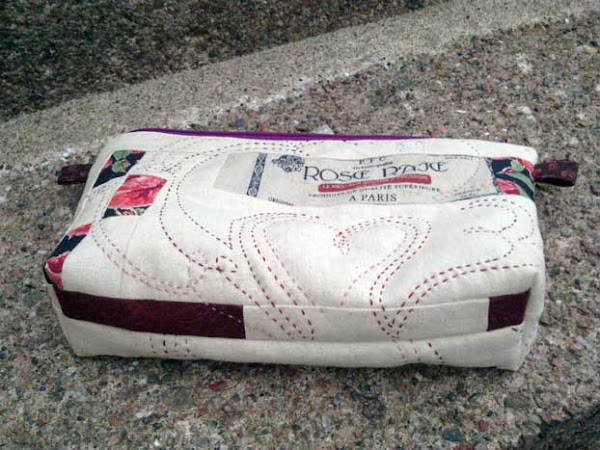
This is a stitching pattern that you can use as an impressive filler. Practice drawing the shapes first: draw a heart, then an echoing line or two outside the shape, then continue drawing another line that becomes the beginning of your next heart shape. Repeat the echoing and move to the next heart shape, and so on.When you can draw a series of hearts fluently in a continuous line, you are ready to stitch the same pattern on your sewing machine.
Because several stitching lines will always look much better than one on its own.
Final words
There! Now you have 21 easy quilting patterns to choose for your next patchwork surface.Even if you don’t love quilting, a few of these ways are bound to be easy enough to do – and yet give a fine finishing touch on your creation! When you start quilting, you are likely to come up with your own variations, and you will find your own favourites.
And as you see from the examples, quilting does not have to be elaborate to be effective.


Comments
I am glad you do the blog in English. I have to rethink my blog language, too.
Greetings from Germany, Martina