A quilter’s praise for the simple square
A square is a great shape in quilts. I’m may seem to be stating something obvious because the majority of quilt blocks are square, but this is not the single reason for the square’s greatness.
Squares and other straight-edged shapes are easy to handle. In contrast, sewing a flat surface out of curvy shapes is difficult, and thus a great way to show off your sewing skill. One will never be admired for one’s ability to sew squares together!
Because quilting is not a competition sport for me, I don’t mind taking things easy. One of the things I love about squares is that when you sew a piece, press and trim it into an exact square, it will be easy to sew together with a similar one and create a flat surface. It takes a bit more time and accurate trimming, but no elite expertise.
Just look at these un-pressed, un-trimmed nine-patch pieces and imagine how hard it would be to sew them together like they are here, and avoid the seams turning willy-nilly!
When the size of the block is uniform, this creates freedom on the quilt level.
Then, the humble square gets a completely different look in a quilt when set on point. I chose this approach for my Between the Darkness and the Light quilt from 2024: In the planning phase, though, I miscalculated the number of squares that I would need and there were enough of them left over so I could make another (though smaller) quilt. Next time, I will be more careful with my calculations!
The colourful squares in the Herkkupalat / Treats quilt from 2018 are also set on point. What’s more, the additional strips will later create a subtle, three-dimensional effect on the finished quilt. The colourful squares look like they are casting a shadow on a light surface that they are floating above. I later made another quilt of these blocks and subsequently wrote the Talisman pattern, which you can purchase as an instantly downloadable PDF version from the Tilkkunen webshop.
Here's a photo of the original Herkkupalat/Treats, which for a long time was my favourite make of all my quilts (and still is in the top 5 of my favourites):
My chosen effect in 2018-2023 was to cut the humble squares very small and yet, sew them into a good-sized quilt, Sattumankauppaa / Random Deals. It took me nearly five years from start to finish. The small squares were of size 4 cm x 4 cm, which became a 4-patch, trimmed into a 2,5” square.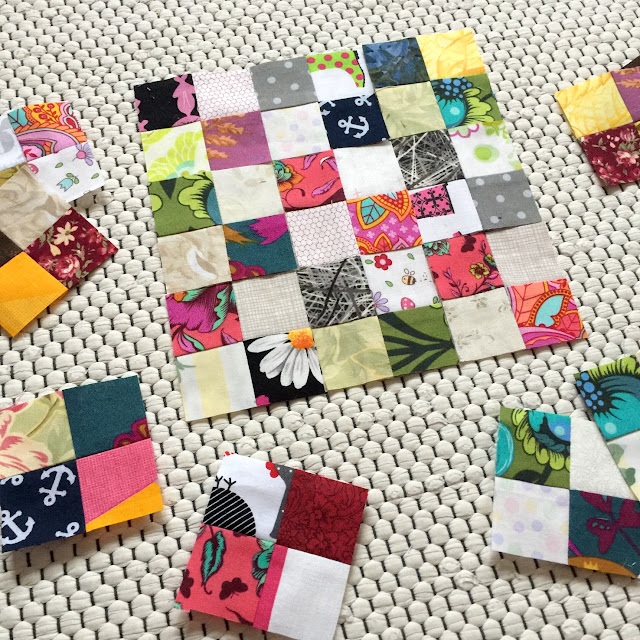 Of course you want to see the finished Random Deals quilt:
 One of my most addictive projects was the Upswing / Noususuhdanne quilt from 2022. The scrap-in-a-box blocks begin with a small scrap, then one adds scrappy strips all around it, presses and trims to size.
 I would start making a few blocks, then found it hard to stop making more. I would think: ”I’ll make one more,” and then I would sew another one – and end up making a series of 10 or 15 blocks. Or more!
When I added the strips around the small scrap, there was often a small piece of strip left over – which then became the centre piece for another block. I was like a perpetual machine at work!
As early as in 2010, I made similar blocks, only using larger scraps and strips. I used cardboard templates with a whole at the centre – so that I could see where the centre scrap would be in the finished square. (I can’t remember though if I actually cut my squares using the cardboard templates.)
A beginner quilter might think it requires careful cutting of triangles and even more careful sewing those into the blunted corners of a square, but a seasoned quilter knows a much easier way.
Take a larger square and four suitably smaller ones, sew a diagonal seam on the smaller ones placed on the corners of the larger one, then flip – and you will have a square that from a distance will look very much like a circle shape.
In 2013, I started making very small such blocks. This is the situation before the flip manoeuver: I looked at the above photo and thought the pieces looked great like that! My snowball blocks were far less impressive:
 Perhaps that’s why this piece languished in my cupboard for 12 years before I finally sewed into a zipper bag panel which then became part of the finished Trellis/Ristikko quilted zipper bag in year 2025:
 A variation of the Snowball block is the square in a square, where the corners are just the right size to make the block look like a square on point within a different-coloured square. It should be possible to create such a square in exactly the same size, but I don’t always succeed. That is why I trim my resulting squares – and some of the corners of the on-point square may be less than sharp.
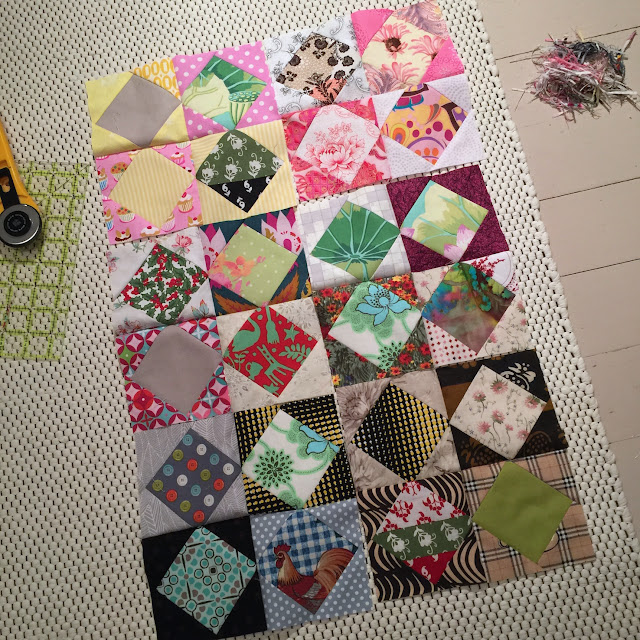 In the finished Pöydät täyteen / Tables Full quilt, the blunt corners aren’t really visible:

 The resulting quilt got the name Pellervontie after the street where my husband and I had our first real home in the Käpylä district in Helsinki.
 Later I realised that perhaps other people might have the same challenge – wanting to use a large-patterned fabric – and created the commercial block/quilt pattern called Käpylä, which you can purchase as an instantly downloadable PDF version from the Tilkkunen webshop.
I love the improvisational look of squares sewn by combining random-sized scraps. My Quirky / Oikukas quilt is a great example: I sewed very small, scrappy square-in-a-box blocks, trimmed them and added black strips all around. After pressing this piece, I cut a new square out of it but at a random angle.
All pieces except the scraps are squares, but the surface looks playful (and quirky)!
I followed this recipe when making the squares that later found their place in my Inner Sweater / Sisäinen villapaita quilt: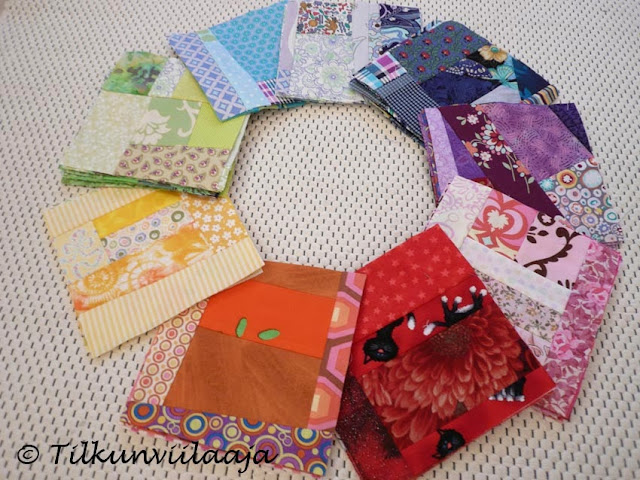 I first sewed small pieces (of the same colour, or sort of the same colour) together, chain sewing as many as I could pick from a pile of scraps next to the sewing machine.
I separate the scrappy pieces and trim the seams if necessary. Then I press them and return to the sewing machine. I look at the same-colour pieces and see if I could sew any of them together. If not, I will rummage through the scrap pile to find suitable additions.
This sewing and pressing continues until the scrappy piece is large enough to be cut into the block-size square.
An important part of this process is to place the pressed and trimmed scrappy squares on the floor and look and admire them every once in a while during the making of more such squares.

That said, I have sewn square items - quilted wall textiles – and Frog Prince / Sammakkoprinssi is an example. This is a picture of the Frog Prince in progress: I made the Frog Prince to a specified size of 90 cm x 90 cm for an exhibition, which was then cancelled because of Covid. Sigh!
The second negative thing related to the square shape in quilting - a minor peeve - is some people’s idea of it.
It bothers me when people refer to “a simple patchwork of squares for beginners” because such a patchwork requires a lot of matching of seams. Also, a good result requires that one has indeed cut the squares exactly to the same size. It would be so much easier for a beginner to cut and sew pieces whose seams do not have to match!
One should never underestimate the square shape when quilting!
If you want to follow my quilting endeavours and catch all my quilt thinking posts, you can subscribe to my biweekly email newsletter. In the newsletters, I share links to my latest blog posts. Subscribe to my biweekly newsletter.
(When subscribing, remember to take the second step: you will get an email asking you to confirm. My emailing system can only send you the newsletters if you have clicked on the button in that email.)
Squares and other straight-edged shapes are easy to handle. In contrast, sewing a flat surface out of curvy shapes is difficult, and thus a great way to show off your sewing skill. One will never be admired for one’s ability to sew squares together!
Because quilting is not a competition sport for me, I don’t mind taking things easy. One of the things I love about squares is that when you sew a piece, press and trim it into an exact square, it will be easy to sew together with a similar one and create a flat surface. It takes a bit more time and accurate trimming, but no elite expertise.
Just look at these un-pressed, un-trimmed nine-patch pieces and imagine how hard it would be to sew them together like they are here, and avoid the seams turning willy-nilly!
Same-sized squares are interchangeable
The uniform size is handy because one square can fit anywhere on the surface, and can often be turned whichever way if one likes. To me, this means that when I’m laying out the quilt surface, I can concentrate on colour and value placement.When the size of the block is uniform, this creates freedom on the quilt level.
Then, the humble square gets a completely different look in a quilt when set on point. I chose this approach for my Between the Darkness and the Light quilt from 2024:

The colourful squares in the Herkkupalat / Treats quilt from 2018 are also set on point. What’s more, the additional strips will later create a subtle, three-dimensional effect on the finished quilt. The colourful squares look like they are casting a shadow on a light surface that they are floating above.
Here's a photo of the original Herkkupalat/Treats, which for a long time was my favourite make of all my quilts (and still is in the top 5 of my favourites):
Even the modest 4-patch could surprise you
Sew four squares together, and you get a simple, square block. Though it may be considered a “beginner’s block,” one can create very non-beginner-looking quilts using it to effect.My chosen effect in 2018-2023 was to cut the humble squares very small and yet, sew them into a good-sized quilt, Sattumankauppaa / Random Deals. It took me nearly five years from start to finish. The small squares were of size 4 cm x 4 cm, which became a 4-patch, trimmed into a 2,5” square.
When I added the strips around the small scrap, there was often a small piece of strip left over – which then became the centre piece for another block. I was like a perpetual machine at work!
As early as in 2010, I made similar blocks, only using larger scraps and strips. I used cardboard templates with a whole at the centre – so that I could see where the centre scrap would be in the finished square. (I can’t remember though if I actually cut my squares using the cardboard templates.)
A square becomes a circle (well, almost)
Though squaring the circle may be an unsolved problem in geometry, it is very simple in quilting to turn a square into a shape that the eye will see as a circle. It is the Snowball block: a square with corners of a different fabric.A beginner quilter might think it requires careful cutting of triangles and even more careful sewing those into the blunted corners of a square, but a seasoned quilter knows a much easier way.
Take a larger square and four suitably smaller ones, sew a diagonal seam on the smaller ones placed on the corners of the larger one, then flip – and you will have a square that from a distance will look very much like a circle shape.
In 2013, I started making very small such blocks. This is the situation before the flip manoeuver:
Squares complement (and become) other shapes
The square plays an important role in these blocks that later became part of my Early to Rise / Aamuvirkku quilt. One part of the block is sewn of squares, and the corners of the flying geese blocks are two sewed-and-flipped squares.Square in a square with square blocks with large squares
In 2019, I wanted to use my lovely Tula Pink unicorn fabrics without cutting them into small pieces – I just couldn’t! So I decided to create a 8,5” square block (unfinished) which would:- let me use my smallish scraps
- be relatively straightforward to sew
- fit nicely with the single-fabric squares that I would cut from the unicorn fabrics.
Squares can look playful
It is fascinating to see a set of scraps transform into an orderly shape, and then notice how easy it is to make a square shape look... well, less orderly!I love the improvisational look of squares sewn by combining random-sized scraps. My Quirky / Oikukas quilt is a great example:
All pieces except the scraps are squares, but the surface looks playful (and quirky)!
The recipe for scrappy square success?
This is the recipe I keep returning to: an odd assortment of scraps + sewn together in an improvisational way + pressed + trimmed into a square = transformation into neatness. And when repeated, the result is many neat squares that together will become a pretty/interesting/fabulous quilt.I followed this recipe when making the squares that later found their place in my Inner Sweater / Sisäinen villapaita quilt:
I separate the scrappy pieces and trim the seams if necessary. Then I press them and return to the sewing machine. I look at the same-colour pieces and see if I could sew any of them together. If not, I will rummage through the scrap pile to find suitable additions.
This sewing and pressing continues until the scrappy piece is large enough to be cut into the block-size square.
An important part of this process is to place the pressed and trimmed scrappy squares on the floor and look and admire them every once in a while during the making of more such squares.
Oh how versatile you are, you square!
In 2011 already, I participated in a fun activity on fabric manipulation (sounds impressive, doesn't it). One of the lasting learnings was how easy it is to take two simple squares, one a bit larger, and create an interesting, slightly three-dimensional and still square shape:
Only two negatives related to the square shape
I came up with only one thing that I don't like about the square shape itself and it is as the shape of the quilt itself. I prefer to sew rectangular quilts.That said, I have sewn square items - quilted wall textiles – and Frog Prince / Sammakkoprinssi is an example. This is a picture of the Frog Prince in progress:
The second negative thing related to the square shape in quilting - a minor peeve - is some people’s idea of it.
It bothers me when people refer to “a simple patchwork of squares for beginners” because such a patchwork requires a lot of matching of seams. Also, a good result requires that one has indeed cut the squares exactly to the same size. It would be so much easier for a beginner to cut and sew pieces whose seams do not have to match!
Final thoughts about the humble square
Just from the examples I shared, it becomes clear that the square shape in all its simplicity is not a limited one. On the contrary, there are infinite possibilities. Scrappy. Multiplied. Tweaked. Complemented. Squares with another square at the center. Strippy squares. So many possibilities...One should never underestimate the square shape when quilting!
If you want to follow my quilting endeavours and catch all my quilt thinking posts, you can subscribe to my biweekly email newsletter. In the newsletters, I share links to my latest blog posts. Subscribe to my biweekly newsletter.
(When subscribing, remember to take the second step: you will get an email asking you to confirm. My emailing system can only send you the newsletters if you have clicked on the button in that email.)


Comments